Compare Google Ads and Meta Ads to understand their differences, targeting, costs, and ROI. Discover which advertising platform best suits your business goals and marketing strategy in 2026.
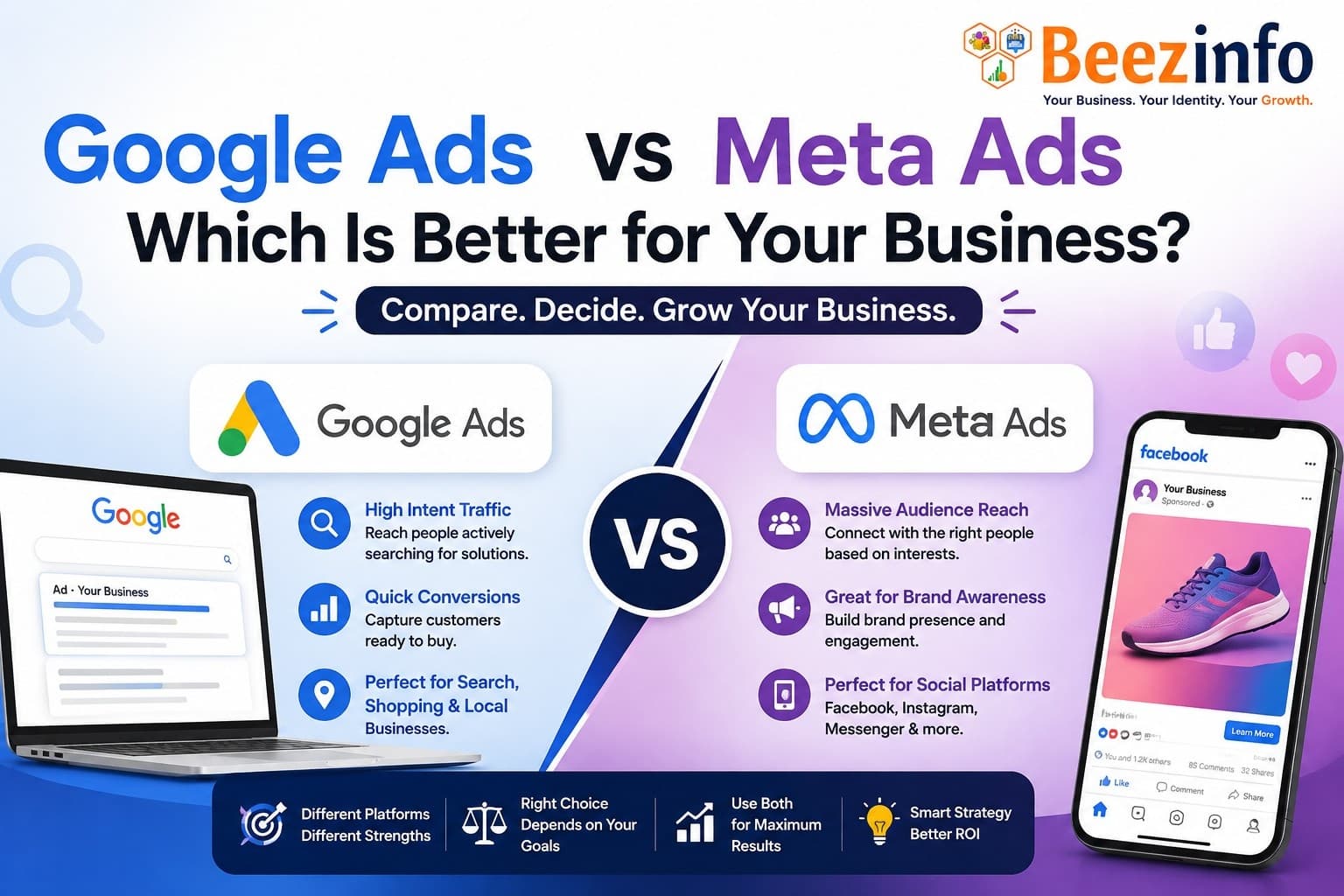
If you're planning to grow your business online, paid advertising is one of the fastest ways to get in front of potential customers. But when it comes to choosing a platform, two names dominate the conversation: Google Ads and Meta Ads (Facebook and Instagram advertising). Both are powerful, both can deliver real results, and both work in very different ways.
So which one is right for your business? The honest answer is: it depends on your goals, your industry, and your budget. In this article, we'll break down how each platform works, their strengths and weaknesses, and how to decide which one deserves your marketing budget — or whether you need both.
If you're looking for expert guidance on digital marketing, SEO, local business listing, and online business growth, visit BeezInfo to explore solutions that help businesses improve their online visibility.
Understanding Google Ads
Google Ads is a search-intent-based advertising platform. It shows your ads to people who are actively typing queries into Google's search engine, looking for a product, service, or piece of information. Google Ads also includes the Display Network (banner ads across millions of websites), YouTube ads, and Shopping ads.
The biggest advantage of Google Ads is that it captures existing demand. If someone searches "emergency plumber near me" or "best CRM software for small business," they already have a need. Your ad simply has to be relevant enough to earn the click.
Strengths of Google Ads
- High purchase intent: Users are actively searching, so conversion rates tend to be strong.
- Keyword targeting: You can target very specific phrases relevant to your business.
- Local reach: Great for local businesses like clinics, restaurants, and service providers.
- Shopping ads: E-commerce brands can showcase products with images and prices directly in search results.
Weaknesses of Google Ads
- Cost per click can be high, especially in competitive industries like insurance, legal services, and finance.
- Limited creative storytelling — search ads are mostly text-based.
- Requires strong keyword research to avoid wasting budget on irrelevant clicks.
Understanding Meta Ads
Meta Ads run across Facebook, Instagram, Messenger, and the Audience Network. Unlike Google, Meta doesn't rely on search intent — it relies on audience targeting based on demographics, interests, behaviors, and lookalike audiences built from your existing customers.
This makes Meta Ads a demand generation tool rather than a demand capture tool. You're not waiting for someone to search for you; you're putting your product or service in front of people who are likely to be interested, even if they weren't actively looking.
Strengths of Meta Ads
- Visual storytelling: Image and video ads make it easy to build brand awareness and emotional connection.
- Granular audience targeting: Target by age, interests, behavior, location, and even life events.
- Lower cost per click in many industries compared to Google.
- Great for retargeting: Re-engage website visitors, cart abandoners, and past customers.
- Strong for impulse and lifestyle products, especially in e-commerce and consumer goods.
Weaknesses of Meta Ads
- Lower purchase intent — users are scrolling, not searching, so conversions can take longer.
- Ad fatigue: Creative needs to be refreshed regularly to avoid declining performance.
- iOS privacy changes have made tracking and attribution more challenging in recent years.
Google Ads vs Meta Ads: Key Differences
| FactorGoogle AdsMeta Ads | ||
| Intent | High (search-based) | Lower (interest-based) |
| Format | Mostly text, some visual (Shopping/Display) | Highly visual (image/video) |
| Best for | Capturing existing demand | Creating new demand & brand awareness |
| Targeting | Keywords, location, demographics | Interests, behaviors, lookalikes |
| Funnel stage | Middle to bottom (ready to buy) | Top to middle (awareness, consideration) |
| Cost | Often higher CPC in competitive niches | Generally lower CPC, but varies by audience |
Which Platform Is Better for Your Business?
There's no universal winner — the right choice depends on your business model.
Choose Google Ads if:
- You offer a service people actively search for (plumbing, legal advice, software solutions).
- You run a local business and want to appear when nearby customers search for you.
- You sell products with clear buyer intent, like electronics or appliances.
- Your goal is direct response and immediate conversions.
Choose Meta Ads if:
- You sell visually appealing products (fashion, beauty, home decor, food).
- You're building brand awareness for a new business.
- You want to retarget website visitors or run lookalike campaigns.
- Your target audience skews younger or is highly active on social media.
Use both if: Many successful businesses don't choose one over the other — they use Meta Ads to build awareness and drive traffic, then use Google Ads to capture that demand when people later search for the brand or product. This combined approach often produces stronger overall results than relying on a single channel.
Tips to Get the Best Results From Either Platform
- Define your goal first — awareness, leads, or sales — before choosing a platform.
- Start with a modest test budget and scale what performs well.
- Track conversions properly using Google Analytics and Meta Pixel/Conversions API.
- Refresh your creative and ad copy regularly to avoid fatigue, especially on Meta.
- Optimize your landing pages — even the best ad campaign fails if the landing page doesn't convert.
- Review performance weekly and adjust bids, audiences, or keywords based on data, not guesswork.
Final Thoughts
Google Ads and Meta Ads aren't really competitors — they serve different purposes in the customer journey. Google Ads is excellent at capturing people who already know what they want, while Meta Ads excels at introducing your brand to people who don't yet know they need you. The smartest marketing strategies usually blend both platforms, using each one for what it does best.
If you're just starting out, evaluate your product, your audience, and your budget honestly. A local service business with high search intent may see faster ROI from Google Ads, while a visually driven consumer brand may find Meta Ads more cost-effective for building an audience. Whichever route you choose, consistent testing and optimization will always matter more than the platform itself.
Frequently Asked Questions (FAQs)
1. Which is cheaper, Google Ads or Meta Ads? Meta Ads generally have a lower cost per click, but Google Ads often deliver higher-intent traffic, which can make the overall cost per conversion comparable or even better in some industries.
2. Can I run Google Ads and Meta Ads at the same time? Yes. In fact, running both simultaneously is a common strategy — Meta builds awareness and drives interest, while Google captures users who later search for your brand or product.
3. Which platform is better for small businesses? It depends on the business type. Local service businesses often benefit more from Google Ads, while product-based or lifestyle brands often see better engagement with Meta Ads.
4. Do Meta Ads work without a big budget? Yes, Meta Ads can work with modest budgets, especially for retargeting campaigns aimed at people who already know your brand, since these audiences typically convert better than cold traffic.
5. Is Google Ads better for e-commerce than Meta Ads? Not necessarily. Google Shopping Ads work well for buyers with clear intent, while Meta Ads are strong for discovery-driven purchases and visually appealing products. Many e-commerce brands use both.
6. How long does it take to see results from paid ads? Google Ads can show results within days if targeting is accurate, since intent is already present. Meta Ads may take longer as algorithms need time to learn and optimize toward the right audience.
7. Which platform is easier for beginners? Meta Ads Manager has a more visual, guided interface, which some beginners find easier. Google Ads has a steeper learning curve due to keyword research and bidding strategies, but it offers strong support resources and automated bidding options.