AI search is changing local business discovery. Learn how to improve your online presence, business profiles, reviews, content, and local SEO to increase AI visibility.
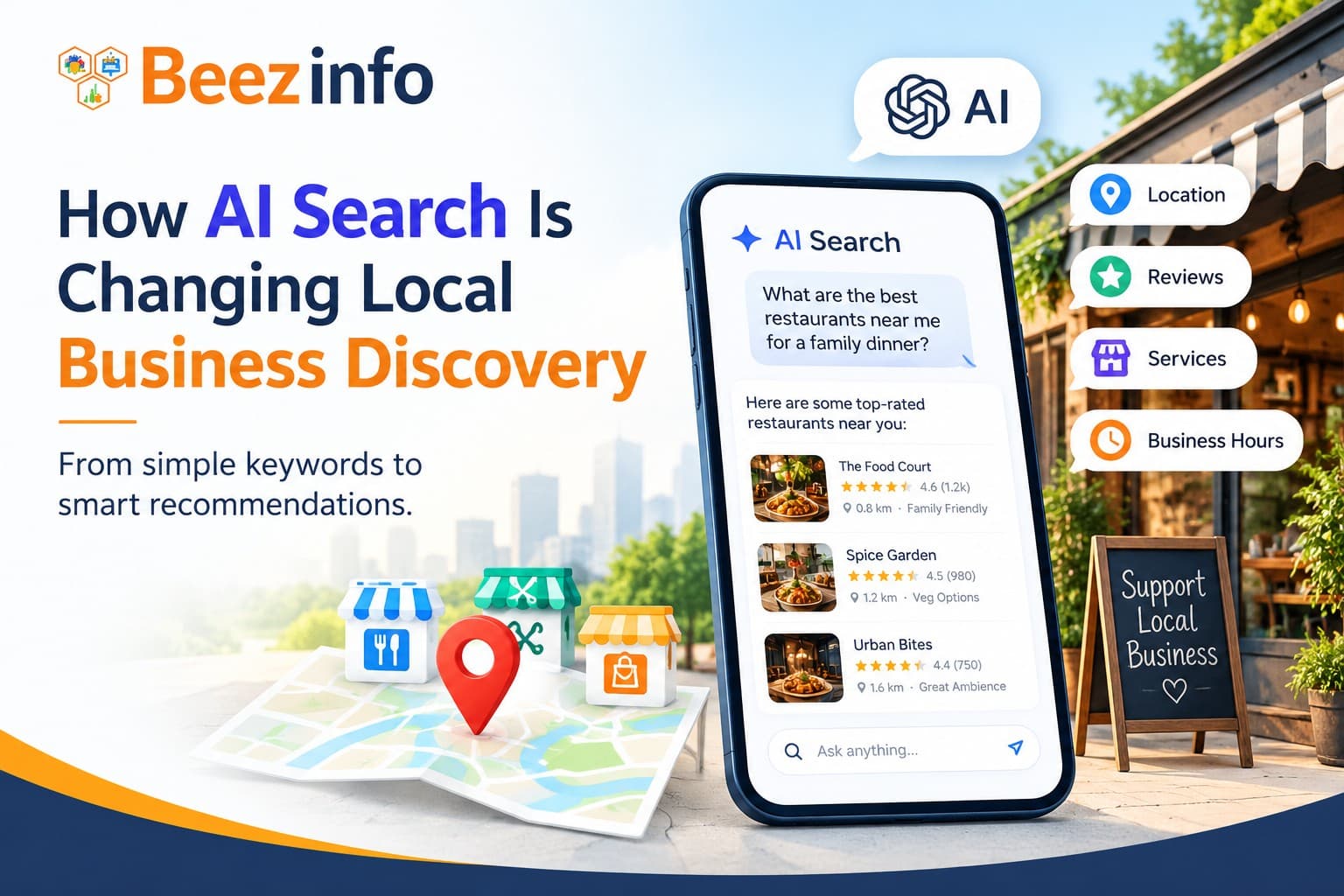
For many years, local businesses have been trying to answer a basic question: “How can I appear higher in Google search results?”
That question is still relevant, but the way people search is changing fast.
Now, businesses also need to consider a new question: “Will AI recommend my business when someone is looking for the services I provide?”
People are no longer just typing short phrases like “best salon near me” or “digital marketing agency in Bhubaneswar.” More users are asking full questions and describing exactly what they need.
For instance:
“What are some good digital marketing agencies for a small business in Bhubaneswar?”
Or:
“Can you suggest a reliable family restaurant near me with vegetarian food?”
These types of searches are quite different from traditional keyword searches. The user isn't simply looking for a webpage—they're looking for an answer.
AI-powered search tools use information from websites, business profiles, reviews, and other online sources to understand these types of questions and provide relevant answers.
Google has also shared that its AI search experiences can include details about local businesses.
This is why having a strong online presence is becoming more important for local businesses.
Your website and business listings are not just places where customers can find your phone number. They also help search engines understand who you are, what you offer, where you operate, and what makes your business stand out.
What Does AI Search Mean for Local Businesses?
Traditional search mainly focused on matching a user's keywords with relevant webpages.
AI search takes a different, more comprehensive approach.
Instead of just looking at individual keywords, AI systems try to understand the meaning, context, and intent behind a question.
Traditional Search vs. AI Search
For example, someone searching for:
“Restaurant in Bhubaneswar”
gives very little information.
But someone asking:
“I need a family-friendly restaurant in Bhubaneswar with good reviews and vegetarian options.”
provides much more context.
They have mentioned the location, the type of experience they want, and an important preference.
For businesses, this means simply repeating a keyword on a webpage isn't enough.
Your online presence should clearly explain what your business does and who it serves.
A local business that provides clear service details, an accurate location, useful content, genuine reviews, and consistent contact information gives search engines more information to work with.
Google also explains that information about businesses can come from various sources, including business owners, websites, users, and third-party platforms.
So, your website shouldn't be seen as your only online identity.
Your Google Business Profile, business directory listings, social media profiles, reviews, and website all contribute to how customers and search engines view your business.
7 Ways to Prepare Your Local Business for AI Search
1. Complete Your Business Profile
One of the simplest things a local business can do is make sure its online information is complete.
Unfortunately, many businesses still have incomplete profiles, outdated phone numbers, old business hours, or very little information about what they offer.
Think of your business profile as your digital identity card.
What Should Your Business Profile Include?
It should tell people, at a glance:
- What your business is called
- What services you provide
- Where you are located
- Which areas you serve
- How customers can contact you
- When you're open
- What your business looks like
- What customers say about you
The more complete and accurate this information is, the easier it becomes for both customers and search platforms to understand your business.
For Indian businesses, BeezInfo can be used to create a digital business profile and list important business information in one place.
A complete profile can help you build a stronger online presence and make your business easier for potential customers to discover.
2. Explain Your Services Clearly
Don't make customers guess what you actually do.
For example, saying:
“We provide complete business solutions.”
doesn't tell a potential customer much.
Compare that with:
“We provide Private Limited Company Registration, GST Registration, MSME Registration, and Digital Signature Certificate services for businesses in Bhubaneswar.”
The second description is much clearer.
A customer immediately knows the services, the target audience, and the location.
How Different Local Businesses Can Explain Their Services
The same principle applies to almost every local business.
If you're a photographer, explain the types of photography you offer.
If you are a restaurant, make sure to include information about the type of food you serve, the different ways customers can dine, and your most popular dishes.
If you run a repair service, clearly explain the kind of repairs you offer and the areas where you provide your services.
It is better to give clear and straightforward information than to use clever or complex language.
3. Write About the Questions Your Customers Actually Ask
Many businesses start a blog simply because they believe it helps with search engine optimization.
However, this often results in articles that are not particularly useful to readers.
A better strategy is to focus on what your customers are asking.
What Questions Do Your Customers Have?
Ask yourself:
- What questions do customers have before making a purchase?
- What information do they need before contacting you?
- What problems are they trying to solve?
- What concerns might stop them from choosing your business?
For example, a GST consultant could create content that answers questions like:
- Who needs GST registration?
- What documents are required?
- How does the GST registration process work?
- How long does it take to register for GST?
- Can a small business register for GST online?
A salon might write about bridal makeup, hair treatments, pricing, and how to prepare for a visit.
A restaurant could answer questions about vegetarian options, family dining, reservations, and delivery.
This kind of content is helpful because it is written for real people, not just search engines.
When your website regularly answers relevant questions, it gives search engines more insight into your expertise and the services you offer.
4. Keep Your Business Details Consistent
A common mistake many businesses make is not keeping their information consistent across different platforms.
Your website might show one phone number, while an old directory listing shows another, and your social media profile may have a different business name.
Even small differences can make your online presence look less professional.
Where Should Your Business Information Be Consistent?
Try to keep your core information the same across your:
- Website
- Google Business Profile
- Business directories
- Social media accounts
- Industry listings
- Review platforms
Google collects business information from many sources, including websites, users, third parties, and business owners.
This is why your online listings should not be treated as separate profiles.
They are all part of your overall digital presence.
5. Do Not Ignore Customer Reviews
Customer reviews are important because they provide real insights into how customers feel about your business.
A business with genuine reviews offers potential customers something that marketing messages cannot: other people's experiences.
How to Build Genuine Customer Reviews
Encourage satisfied customers to leave honest feedback.
Respond to reviews professionally, including negative ones, and use the feedback to improve your service.
Avoid buying fake reviews or asking people to write reviews for services they haven't used.
The goal is not just to have many reviews, but to build real trust in your business.
Over time, customers may naturally describe your business using words like reliable, affordable, professional, quick, or friendly.
These real descriptions can help others understand what your business is known for.
Frequently Asked Questions
1. What is AI search for local businesses?
AI search uses artificial intelligence to understand conversational queries and provide synthesized answers or recommendations. For local businesses, this can include information about businesses, services and locations.
2. How can my business appear in AI search results?
There is no guaranteed method. Start by maintaining accurate business information, building a strong website, creating useful content, managing your Google Business Profile, earning genuine reviews and establishing a consistent presence across relevant online sources.
3. Is Google Business Profile important for AI search?
Yes. Google recommends using Business Profiles to establish and manage business information that can appear across Google Search and Maps, and its current generative-AI guidance highlights Business Profiles for local business visibility.
4. Does SEO still matter with AI search?
Absolutely. SEO remains important because AI-powered search still needs reliable, understandable and accessible information from the web and other sources.
5. What is LocalBusiness schema?
LocalBusiness structured data is a standardized way to communicate information about a local business to search engines. Google supports LocalBusiness structured data and recommends using the most specific applicable business subtype.
6. Do online business directories help with AI search?
A complete and accurate business-directory presence can contribute to your overall digital footprint. However, businesses should prioritize relevant, trustworthy directories rather than creating large numbers of low-quality listings.
7. How important are customer reviews?
Genuine customer reviews can help demonstrate real customer experiences and build trust with potential customers. Businesses should focus on earning authentic reviews rather than using fake or manipulated feedback.
8. Should local businesses create FAQ content?
Yes. FAQs can address the exact questions customers ask about your services, location, pricing, availability and processes. They can also make your website more useful and easier to understand.
9. Can a small business compete in AI search?
Yes. A small business can strengthen its digital presence by clearly explaining its services, maintaining accurate local information, collecting genuine reviews, publishing useful content and building authority in its niche.
10. Is AI search optimization the same as traditional SEO?
Not exactly. There is significant overlap, but AI search places additional emphasis on clear information, context, conversational questions, entity understanding and the overall consistency of information available about a business.
11. How can BeezInfo help my local business?
BeezInfo allows Indian businesses to create digital business profiles containing business information, images and contact details and helps connect businesses with customers searching for services.
12. What should my business do first for AI search?
Start with your fundamentals: complete your business profiles, make your website information accurate, ensure your name/address/contact details are consistent, publish useful content and build genuine customer trust.